Phantom in the Light
The story of early spectroscopy
| Published: | 2025-10-16 |
| Updated: | 2026-07-04 |
| Words: | 3636 |
| Tags: | #science #physics #chemistry #astronomy |
I have set my rainbow in the clouds, and it will be the sign of the covenant between me and the earth.
For much of human history, the rainbow was a supernatural phenomenon. In Judaic religions, it was a sign of God's covenant that he would never kill everyone on earth via a giant flood again.1 In Norse mythology, there was the Bifröst, the rainbow bridge that connected Midgard (the realm of man) to Asgard (the realm of the gods). Iris, in Greek mythology, was the goddess of the rainbow and divine messenger of the gods. For much of human history, the rainbow was as inscrutable as it was inconstructible.23
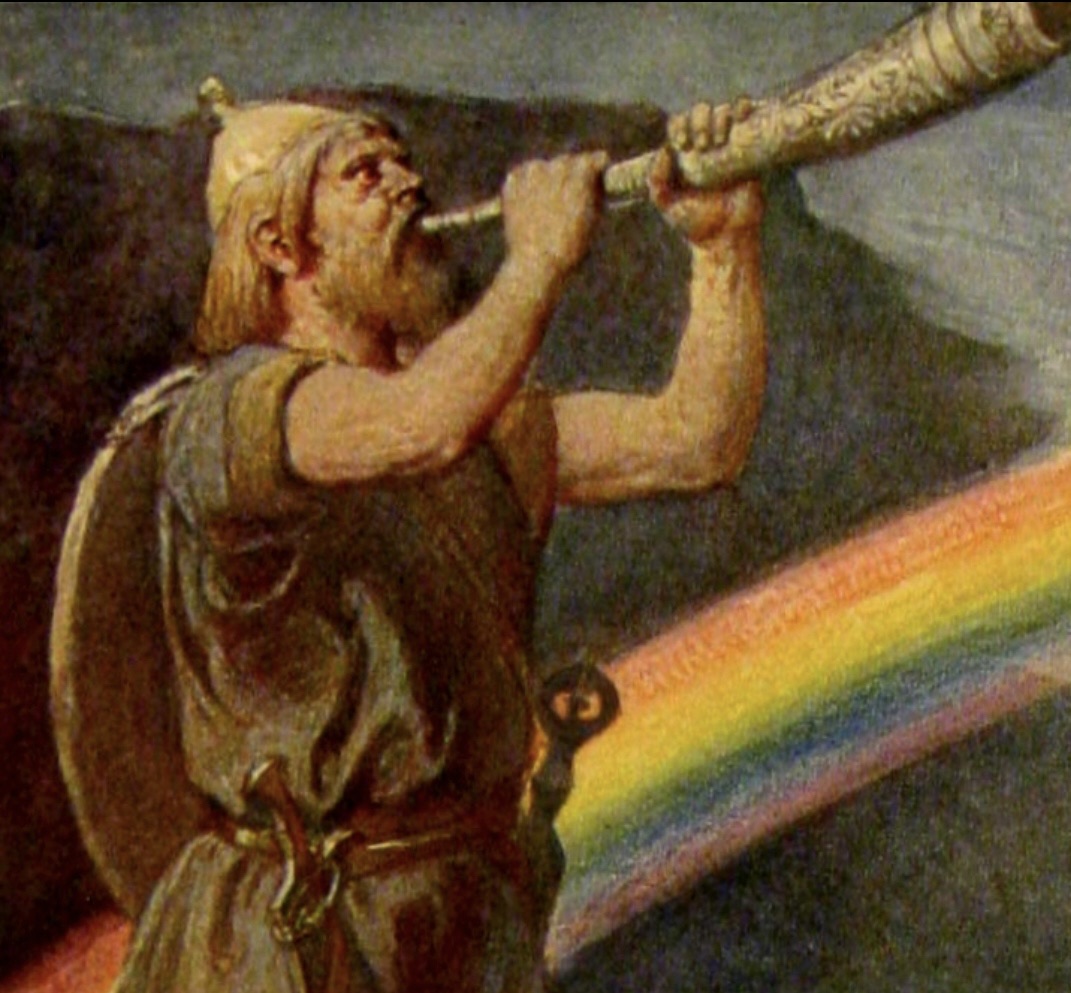
Heimdallr, watchman of the gods, sounds the mighty Gjallarhorn, ending his perpetual vigil from Himinbjörg, where the Bifröst meets Asgard, the realm of the gods, and forewarning the world that the end of times, Ragnarök, is finally upon us. The Bifröst will soon shatter and the earth flood as Gjallarhorn echoes throughout the nine realms. Heimdallr's vigil ends not because he fails but because the time for Ragnarök has arrived, and his duty has been fulfilled. Okay, this image caption is a little long and detracting from the story I'm trying to tell, but what can I say? I like Norse mythology!
Isaac Newton
In 1672, Newton used a prism to divide white light. With this simple experiment, the prevailing Aristotelian dogma of the last 2000 years regarding light was overturned literally in a flash. Until white light came under the scrutiny of Newton's genius, it was thought that white light was pure, that it obtained color through interaction with darkness and matter. Newton showed that it was the other way around. White light is actually a combination of all other colors. Newton nailed the coffin shut on Aristotle's theory of light when he recombined a rainbow back into white light, showing once and for all that white light is indeed a combination.
Newton published the results of his experiments in his book4 Opticks in 1704. 5 In Opticks, he coins the term, "spectrum" (from Latin for "image" or "apparition"), to describe the range of refracted light, which is where we get the modern term, "electromagnetic spectrum."
Likely due to the crudeness of 1670s equipment, Newton did not notice that his spectrum was not actually continuous. There were tiny gaps in his refracted light. These gaps would go unnoticed for another 130 years. But what exactly were these gaps?
Fraunhofer Lines
The gaps in the sun's spectrum were finally noticed in 1802 by an Englishman, William Hyde Wollaston. Wollaston had invented a much-improved spectroscope using lenses that allowed him to view the same spectrum as Newton but in much greater fidelity. But Wollaston didn't know what the gaps were. He assumed they were the "gaps between colors" and left it at that.
Ten years later, the German physicist Joseph von Fraunhofer invented yet another improved spectroscope. Fraunhofer's spectroscope used a diffraction grating in place of a prism 6. A diffraction grating is just thousands of slits placed very close together. This permits two key things over prism-based refraction:
- The spectral resolution is even higher than with Wollaston's prism/lens combo.
- A diffraction grating allows the wavelengths of diffracted light to be measured.
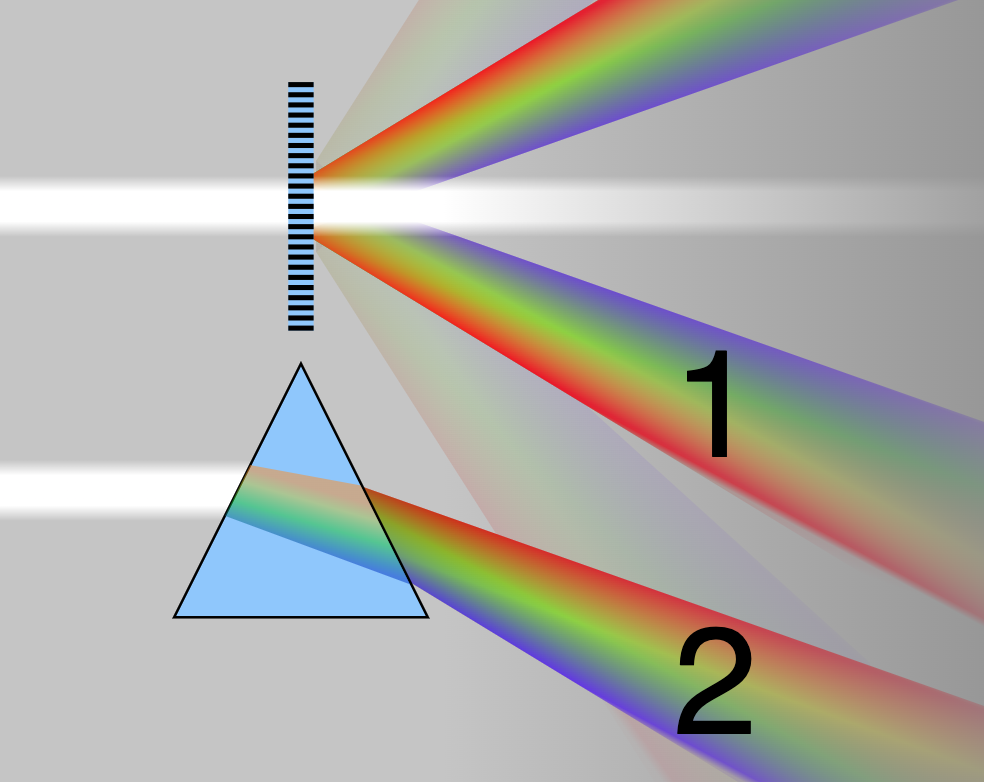
1: Diffraction via diffraction grating. 2: Refraction via prism. Source.
Fraunhofer had never heard of Wollaston's discovery of the gaps in refracted solar light. But in 1814, he incidentally made the same observations. However, unlike Wollaston, Fraunhofer, with his new spectrometer, had the means to actually quantify these gaps. So he set out on a systematic analysis of the gaps in the solar spectrum. He identified 570 distinct lines giving each a unique label. 11 These gaps are now called Fraunhofer lines in his honor, but also referred to as "spectral lines."
With Fraunhofer's spectral measurements, the field of quantitative spectroscopy was born.
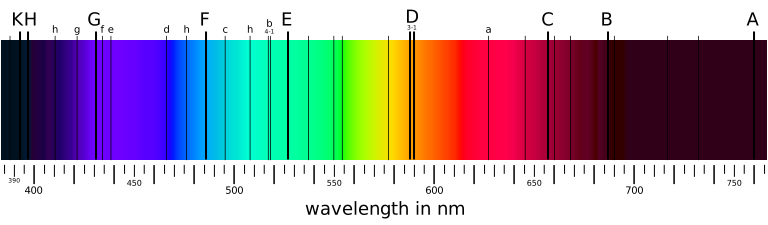
Fraunhofer lines in solar spectrum
Bunsen, Kirchhoff, and the Three Laws of Spectroscopy
Different elements give off specific colors when heated. For example, sodium emits yellow light 12, potassium emits violet light, and strontium emits red light. This is known as the element's emission spectrum. An element's emission spectrum consists of a few bands of light emitted at particular wavelengths.
Notice that this is the opposite of what we were talking about in the previous section. Fraunhofer lines belong to an element's absorption spectrum. An absorption spectrum shows the full visible light spectrum, with particular wavelengths missing, rather than emitted. An element's emission spectrum, on the other hand, is just a few wavelengths (i.e., colors) of light.
The wavelengths that an element emits when heated correspond exactly to the wavelengths that are missing in its absorption spectrum. In other words, they are (almost 13) reciprocal. This is because they both result from the same electron energy transitions—absorption occurs when electrons jump to higher energy levels, emission when they fall back down. It didn't take scientists long to prove this (34 years to be exact 14).
The great thing about absorption spectra is that it makes identifying elements much easier. Just light something on fire and examine the light that's emitted. This discovery was a boon for experimental spectroscopy and led the advancement of not only chemistry but, as we'll soon see, astronomy as well.
Robert Bunsen and Gustav Kirchhoff were the main pioneers in flame spectroscopy (heating elements to examine their emission spectra). Bunsen is a name you've probably mostly heard preceding the word, "burner". Bunsen's eponymous device was designed specifically for the laboratory to maximize heat and minimize luminosity. Remember trying to get the perfect blue flame in chemistry lab? What a dopamine rush when you finally got it! This blue flame is not only the Bunsen burner's peak temperature, it's also nearly colorless at the top! This allows a chemist to burn an element and examine its color with minimal interference from the flame itself.
Burner in hand, Bunsen and Kirchhoff began their systematic analysis of burning a bunch of shit and examining the emitted spectra, publishing their results in 1860. 15 In the process, they discovered two new elements—cesium and rubidium, both of which were named for their emission spectrum. Cesium is Latin for "sky blue", and rubidium is Latin for "deep red".
Kirchhoff, in his three laws of spectroscopy, showed how black body radiation, absorption spectra, and emission spectra relate to one another:
- An incandescent solid, liquid, or gas under high pressure emits a continuous spectrum (that is, containing all wavelengths of visible light without interruptions).
- A hot, low-density gas generates an emission spectrum of bright lines corresponding to discrete wavelengths of light unique to the gas.
- A continuous spectrum viewed through a cooler, low-density gas produces an absorption spectrum, where specific wavelengths are absorbed, creating dark lines in the spectrum.
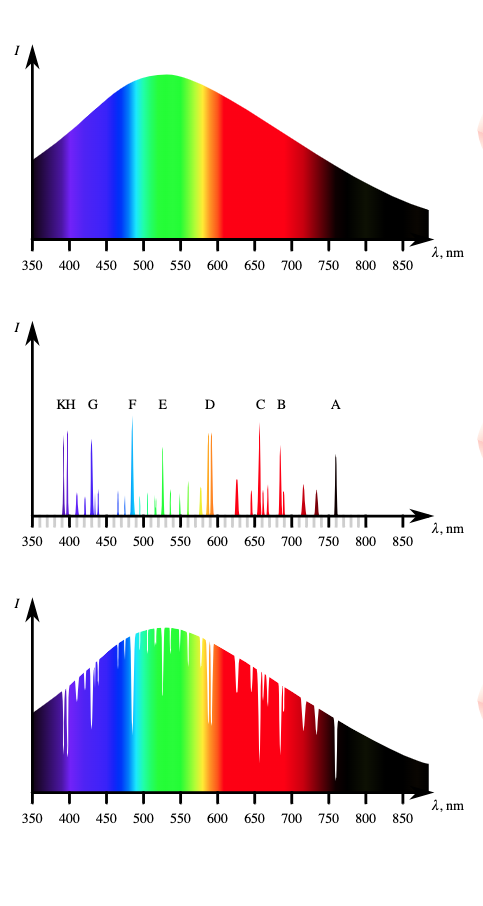
Visual depiction of Kirchhoff's three laws of spectroscopy
Now, those Fraunhofer lines we talked about earlier are starting to make sense! Basically, the sun acts as a source of an enormous amount of black body radiation. That means the core of the sun is generating a continuous spectrum of visible (and non-visible) light (Law 1). But the sun gets cooler and less dense the farther from the center you are. Surrounding the core of the sun 16, is a layer called the photosphere. The photosphere is composed mostly (~98%) of hydrogen and helium gas trapped by the sun's gravity. The continuous spectrum emitted from the sun's core is "filtered" through the photosphere (Law 3). This creates an absorption spectrum where the Fraunhofer lines correspond to hydrogen, helium, sodium, and other trace elements found in the sun's atmosphere.
Twinkle, Twinkle Little Star
Twinkle, twinkle, little star,
How I wonder what you are!
Have you ever thought about the first two lines to "Twinkle, Twinkle, Little Star"? When TTLS was written in 1806, people really didn't know what a star was. They might have guessed that they were "distant suns", but that hadn't been demonstrated in a rigorous scientific manner. The general public was even less clear as to what stars were.
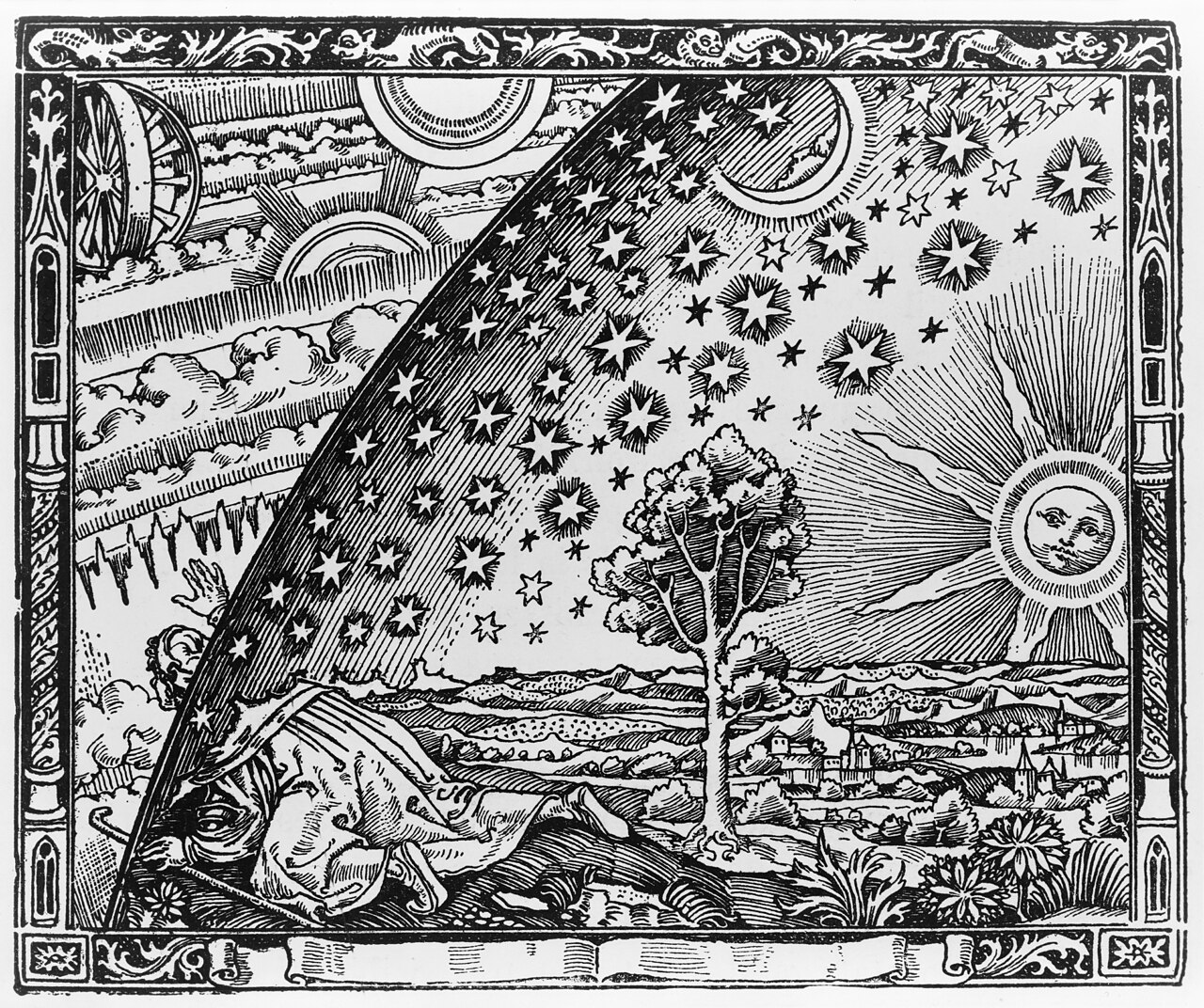
This 1888 woodcut, the Flammarion Engraving, depicts a man reaching into space from "the edge of earth". Note the stars.
Spectroscopy is how we finally learned what stars really are. Scientists applied the same spectroscopic analyses they used on the sun to the stars 17, et voilà, we had an answer to Jane Taylor's poem.
The element, technetium (meaning "artificial" in Greek), for example, had only ever been artificially produced on earth. But in 1952, astronomer Paul W. Merrill detected technetium's spectral signature in the light from a class of stars called S-type red giants. Merrill's observation provided key evidence for the theory that many elements 18 are produced in stars via "stellar alchemy". This is because the most stable isotope of technetium is technetium-97, which has a half-life of 4.21 million years. This might sound like a long time, but from a star's perspective, it's the blink of an eye. 4.21 million years is far too short a time for technetium to have been present during the star's formation, meaning the star, itself, must be producing technetium (see Technetium star).
Technetium is not the only element forged in stars. Nearly every known element except for hydrogen (which was produced during the big bang) and the transuranic elements (too unstable) was at some time made in a star. 19 In other words, 90% of your body mass came from a star at some point! The other 10% of you (hydrogen) is about 13.8 billion years old, formed during the big bang. Carl Sagan worded it best:
We are star-stuff, the ash of stellar alchemy.
In just 150 years, humanity went from not having a clear idea of what stars were to being able to determine, through spectroscopy, their exact composition. And from their composition we can determine their lifecycle and the processes taking place inside them.
Conclusion
The inspiration for this story came from Isaac Asimov's book, Isaac Asimov's Guide to Earth and Space (1991). This is an embellished account of the same story he told there (with a few minor corrections 20).
It's fascinating how knowledge evolves over time and how we can use science to shape our understanding of the universe. With a few simple experiments on light, we can show that we are made from stars. I think the true nature of reality lies well beyond human imaginative capability, but science (and math and technology) allow us to peer just a little further into the darkness.
I'll end with this quote from Hamlet. The full passage is one of the best in all of literature. Hamlet's existential ruminations to Rosencrantz and Guildenstern are eerily prescient (pun intended) of not only existentialism but modern science as well.
this brave o’erhanging
firmament, this majestical roof, fretted
with golden fire — why, it appeareth nothing to me
but a foul and pestilent congregation of vapors.
What a piece of work is a man, how noble in
reason, how infinite in faculties
...
yet, to me, what is this quintessence of dust?